
Root Canal vs.
Tooth Extraction in Costa Mesa
Facing a damaged or infected tooth? Before you decide, understand what each option actually means for your smile, your bite, and your long-term oral health.
When a tooth is badly infected or severely damaged, you’re often faced with a choice: save it with a root canal, or remove it with an extraction. Both solve the immediate problem — but they lead to very different outcomes for your jaw, your bite, and your long-term dental health. At Brite Clean Smiles in Costa Mesa, we always try to save natural teeth first. Here’s what you need to know before making the call.
How They Compare at a Glance
A clear breakdown of root canal therapy and tooth extraction across the factors that matter most — tooth preservation, bone health, recovery, and long-term outcomes.
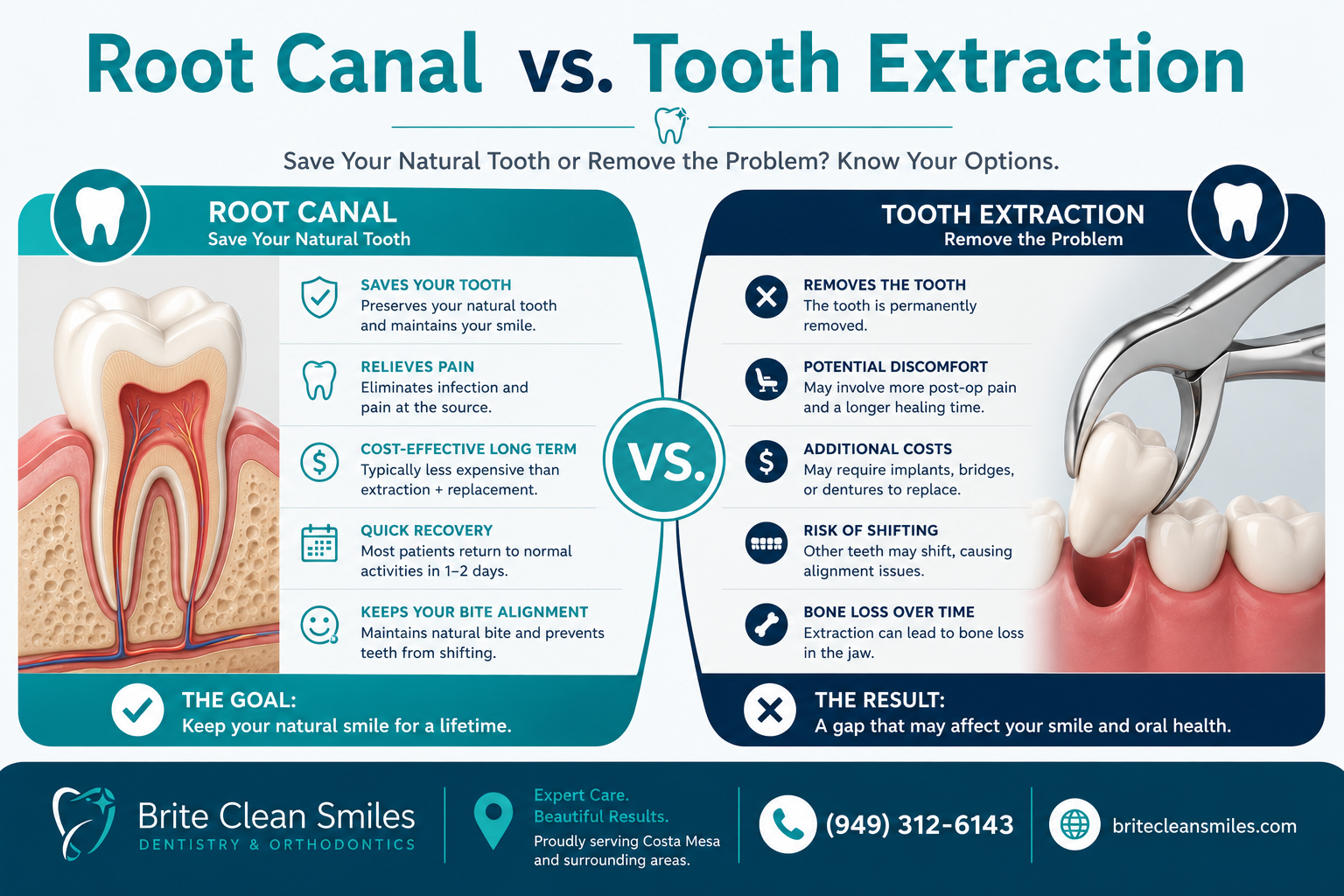
Root Canal vs. Tooth Extraction
Both eliminate the problem — but what happens to your mouth afterward is where they diverge significantly. Here’s an honest look at what each treatment actually involves.
Save Your Natural Tooth
- Removes the infected pulp while keeping the natural tooth structure intact
- The root stays in place — continuing to stimulate the jawbone and prevent bone loss
- Bite alignment and neighboring teeth stay undisturbed — no shifting or drifting
- Capped with a crown — restored tooth functions exactly like a natural one
- Recovery typically 1 to 2 days — most patients return to normal quickly
- Dentists almost always recommend this when the tooth can still be saved
Remove the Problem Tooth
- The entire tooth and root are permanently removed from the socket
- Without a root, the jawbone begins to resorb — most significant in first 3 to 6 months
- Neighboring teeth gradually shift into the gap, altering your bite over time
- Replacement — implant, bridge, or denture — needed to prevent further drift
- Recovery is longer — swelling and soreness can persist up to two weeks
- The right choice when a tooth is fractured below the gumline or beyond saving
What Each Procedure Actually Involves
Understanding what happens during and after each treatment makes it a lot easier to weigh your options clearly — and set realistic expectations for recovery.
How a Root Canal Works
Root canal therapy removes the infected or inflamed pulp tissue from inside the tooth — the nerve, blood vessels, and soft tissue — while leaving the outer shell of the tooth completely intact. The canals are cleaned, shaped, and sealed with a rubber-like material called gutta-percha, then the tooth is capped with a custom dental crown to restore its full strength and function.
The procedure is performed under local anesthesia — you should feel pressure, but not pain. Most patients are surprised by how manageable the experience is compared to their expectations. Studies from the American Association of Endodontists consistently show that patients who have had root canals are six times more likely to describe the procedure as painless compared to those who had an extraction.
Recovery is typically one to two days of mild soreness — over-the-counter pain relief is usually sufficient — and most patients return to normal eating and daily routine within a day or two.
The Tooth Stays
Only the infected soft tissue inside is removed. The root, the crown, and the position in your jaw all remain exactly as they were.
No Bone Loss
Because the root stays in place, the jawbone continues to receive stimulation with every bite — preventing the resorption that follows an extraction.
Bite Stays Intact
No gap means no drift. Your neighboring teeth, your chewing mechanics, and your bite alignment all stay exactly where they should be.
Crowned and Restored
After the root canal, a crown protects the treated tooth. Once placed, it functions exactly like a natural tooth — no restrictions.
How an Extraction Works
A tooth extraction permanently removes the tooth — root and all — from the socket. Simple extractions involve loosening and lifting a visible tooth with forceps; surgical extractions (for broken, impacted, or complex teeth) involve a small incision and sometimes sectioning the tooth for safe removal.
Both are done under local anesthesia with sedation options available. Recovery is more involved than a root canal — most patients experience swelling and soreness for three to seven days, with full soft tissue healing taking one to two weeks. The bone underneath continues to remodel for several months.
The important thing to understand about extraction is what comes next. Leaving the space empty sets off a chain reaction: the jawbone at the extraction site loses density because there’s no root to stimulate it. Neighboring teeth begin tilting into the gap. Bite balance shifts. If you’re considering extraction, replacement — via a dental implant, bridge, or denture — should be part of the plan from the start.
When Extraction Is the Right Call
A tooth fractured below the gumline, severe bone loss from gum disease, or structural damage that leaves nothing worth saving — these are the cases where extraction makes clinical sense.
Bone Resorption Is Immediate
The most significant bone loss happens in the first 3 to 6 months after extraction. If you’re planning an implant, early placement preserves the most bone.
Neighboring Teeth Will Drift
Without a tooth holding the space, adjacent and opposing teeth gradually shift — affecting your bite and making future dental work more complex.
Plan for Replacement from Day One
An extraction without a replacement plan is only half a solution. An implant, bridge, or partial denture should be considered before or immediately after removal.
When Each Option Makes the Most Sense
The decision isn’t always straightforward — it depends on the extent of damage, the tooth’s structural integrity, and what’s visible on X-ray. Here’s a general guide.
Root Canal Tends to Apply When
- The tooth has a healthy root and enough structure to support a crown
- Infection or inflammation is inside the pulp but hasn’t destroyed the root
- The tooth is visible and important for bite alignment or chewing
- You want to preserve bone and avoid a replacement procedure
- The dentist confirms the tooth is salvageable on X-ray
Extraction Tends to Apply When
- The tooth is fractured below the gumline and cannot be restored
- Advanced gum disease has destroyed the surrounding bone support
- The tooth is severely decayed with too little structure remaining
- A failed previous root canal has left the tooth non-restorable
- Wisdom teeth causing crowding, impaction, or repeated infection
When Only an Exam Can Decide
- Tooth appears damaged but the root condition isn’t clear without X-ray
- Partial fracture that may or may not extend below the gumline
- Previous root canal that may or may not need retreatment
- Infection present — scope of damage only visible on imaging
- Any case where a second opinion feels important before deciding
Not Sure Whether to Save or Remove the Tooth?
An X-ray and exam are the only way to know for certain what the tooth can support. Our Costa Mesa team will give you a straight answer — and a treatment plan that puts your long-term health first.
Root Canal vs. Extraction — FAQs
The questions we hear most when patients are facing this decision in Costa Mesa.
Is it better to pull a tooth or get a root canal?
When the tooth can be saved, dentists almost universally recommend a root canal. Preserving your natural tooth maintains your bite alignment, prevents the jawbone from shrinking, and keeps neighboring teeth from drifting into the gap. An extraction solves the immediate problem but creates a new set of long-term considerations — bone loss, shifting teeth, and the need for a replacement. Extraction is the right call when the tooth is genuinely beyond saving — fractured below the gumline, destroyed by bone disease, or structurally unsalvageable. But “easier” or “cheaper upfront” are not good reasons to choose it over a root canal.
Does a root canal hurt more than pulling a tooth?
Contrary to popular belief, root canals are not more painful than extractions — and research consistently supports the opposite. Both are performed under local anesthesia, so neither should be painful during the procedure. The difference is in recovery: root canal patients typically experience mild soreness for one to two days. Extraction recovery involves more significant swelling, a longer healing timeline of up to two weeks, and specific risks like dry socket that require careful aftercare. The reputation root canals have for being painful largely reflects what the tooth felt like before treatment, not during or after it.
What happens to your jaw if you pull a tooth and don’t replace it?
The jawbone at the extraction site begins resorbing within weeks of losing the tooth root — the bone no longer receives the stimulation it needs to maintain its density. The most significant volume loss happens in the first three to six months. Over time, this changes the shape of your jaw, can affect the fit of neighboring restorations, and makes future implant placement more complex (often requiring bone grafting first). Neighboring teeth also gradually tilt and drift into the open space, shifting your bite in ways that can be difficult and expensive to correct later.
How long does a root canal take to heal?
Most root canal patients feel back to normal within one to two days. Some mild tenderness around the treated tooth is common for a few days, especially when biting down, but this resolves quickly. The tooth itself is technically “healed” once the infection is cleared and the canal is sealed — usually completed in one to two appointments. The crown that follows the root canal is placed at a separate visit and restores full chewing function. In contrast, extraction site healing takes one to two weeks for soft tissue and several months for the underlying bone to fully remodel.
Can a tooth be too infected for a root canal?
In most cases, no — infection alone doesn’t disqualify a tooth from root canal treatment. In fact, a root canal is specifically designed to eliminate the source of infection. However, if the infection has spread extensively into the surrounding bone, compromising the tooth’s structural integrity and support, extraction may become necessary. In some cases, antibiotics are prescribed first to reduce acute infection before root canal treatment is performed. What makes a tooth truly non-restorable is usually the extent of physical damage — not the infection itself — which is why imaging is essential to the decision.
If I get a tooth pulled, do I need to replace it right away?
Not immediately — but the sooner you plan for replacement, the better. Bone loss begins in the weeks following extraction, and the longer the gap remains, the more bone volume you lose. If you’re planning a dental implant, earlier placement typically means more available bone and a simpler procedure. If budget or timing is a factor, a temporary removable option can hold the space while you prepare for a permanent solution. What you want to avoid is leaving the gap indefinitely — the downstream consequences in bone loss and tooth drift make future treatment progressively more complex.
Schedule Your Consultation in Costa Mesa
Reach out and we’ll get you scheduled. We’ll examine the tooth, review your X-rays, and give you a clear recommendation — with your long-term health as the priority.
Location
488 E 17th St. Suite A-101
Costa Mesa, CA 92627
Hours
Mon–Thu: 8am–4pm
Friday: 8am–1pm
Tooth Pain Doesn’t Have to Mean Losing a Tooth
In most cases we can save it. Let our Costa Mesa team take a look — we’ll give you a straight answer and a plan that puts your long-term health first.
