
Is It Safe to Remove Amalgam Fillings? The SMART Protocol Explained
What the science actually says about silver fillings, when replacing them makes sense, and how a mercury-safe removal protocol protects you in the chair.
The short answer: yes, amalgam fillings can be removed safely when removal is clinically indicated, and the safest removals follow strict protective protocols. But here is the part responsible dentistry insists on: the FDA and ADA advise against removing intact, well-functioning amalgam fillings solely because they contain mercury, since drilling out a healthy filling creates more exposure than leaving it alone. This article covers when removal genuinely makes sense, and exactly how it is done safely.
Silver amalgam fillings have been used for well over a century, and if you grew up before tooth-colored fillings became standard, there is a good chance you have a few. They contain roughly half elemental mercury by weight, bound together with silver, tin, and copper. That word, mercury, is what brings most patients to this article, so let us deal with it honestly, without fear-mongering and without dismissing the question either.
At Brite Clean Smiles, mercury-safe removal is one of the signature services of our biological dentistry practice. That gives us every commercial reason to tell you to remove your fillings, which is exactly why we won't. What we will do is explain the evidence, the indications, and the protocol, so you can make the decision with clear eyes.
When Does Replacing An Amalgam Filling Actually Make Sense?
Amalgam fillings do not last forever. Like any restoration, they age, and an aging amalgam filling gives clear signals that its useful life is ending. These are the situations where removal and replacement is the clinically sound choice, not an elective one:
Decay Under Or Around The Filling
Recurrent decay at the edges of an old filling is the most common reason for replacement. The filling must come out to treat the cavity beneath it.
Cracked Or Fractured Fillings
Amalgam expands and contracts with temperature over the years. A cracked filling no longer seals the tooth and can crack the tooth itself.
Failing Or Leaking Margins
When the seal between filling and tooth breaks down, bacteria slip underneath. X-rays and clinical exams catch this before it becomes a root canal.
Documented Sensitivity Or Allergy
A small number of patients have a confirmed allergy or sensitivity to amalgam components. With documentation, replacement with an alternative material is appropriate.
Some patients also choose replacement for cosmetic reasons or as a personal preference toward metal-free restorations. That is a legitimate choice to discuss openly with your dentist, and when you make it, the removal method matters enormously. Which brings us to the protocol.
What Is The SMART Protocol?
SMART stands for the Safe Mercury Amalgam Removal Technique, a set of protective measures developed by the International Academy of Oral Medicine and Toxicology (IAOMT). Its entire purpose is to minimize mercury vapor and particle exposure for the patient, the dental team, and the environment during removal, because the moment of drilling is when exposure peaks.
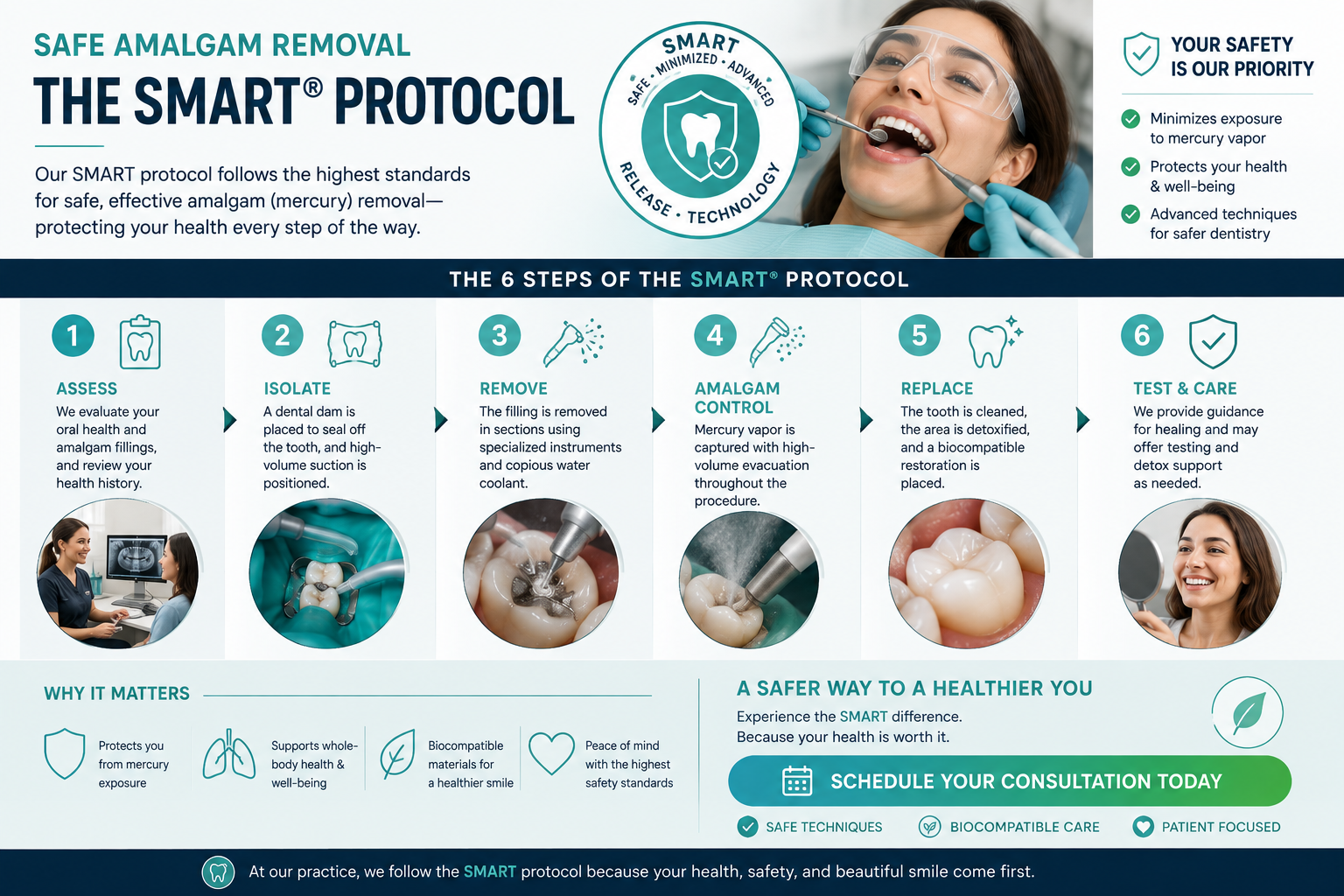
Here is what a SMART removal looks like in the chair:
- Rubber dam isolation. A non-latex barrier seals off the tooth being treated, so particles and vapor cannot reach your mouth or throat.
- External oxygen supply. You breathe clean air through a nasal mask during removal, bypassing the air immediately around the tooth.
- High-volume suction and air filtration. A powerful evacuator positioned at the tooth, often paired with an ambient air filtration unit, captures vapor and particles at the source.
- Copious water cooling. Constant water spray keeps the filling cool while drilling, because heat is what drives mercury vapor release.
- Sectioning the filling. Rather than grinding the amalgam to dust, it is cut into chunks and removed in large pieces, dramatically reducing the amount aerosolized.
- Full barriers and safe disposal. Protective coverings for you, PPE for the team, and an amalgam separator that keeps mercury out of the water supply.
This is the standard we follow for every amalgam removal at our Costa Mesa office. You can read more about the service itself on our safe amalgam removal service page and our Costa Mesa amalgam filling removal page.
Vapor Is The Target, Not Swallowed Particles
Here is a detail that surprises most patients and explains why the protocol looks the way it does. If a tiny particle of amalgam is swallowed, it passes through the digestive system with very little mercury absorbed. Elemental mercury in solid form is poorly absorbed by the gut, which is why an accidentally swallowed fragment is not the emergency people fear.
Mercury vapor is a different story. Vapor released by heat and grinding is readily absorbed through the lungs, and that is precisely the exposure route every SMART measure attacks: water cooling to prevent heat, sectioning to prevent grinding, suction to capture what escapes, and external air so you never breathe near the source.
Understanding that distinction is also why the FDA position makes sense. An intact filling at rest releases minimal vapor. Drilling one out unnecessarily creates the very exposure event the removal was supposed to avoid. The protocol exists for the removals that are worth doing.
What Replaces An Amalgam Filling?
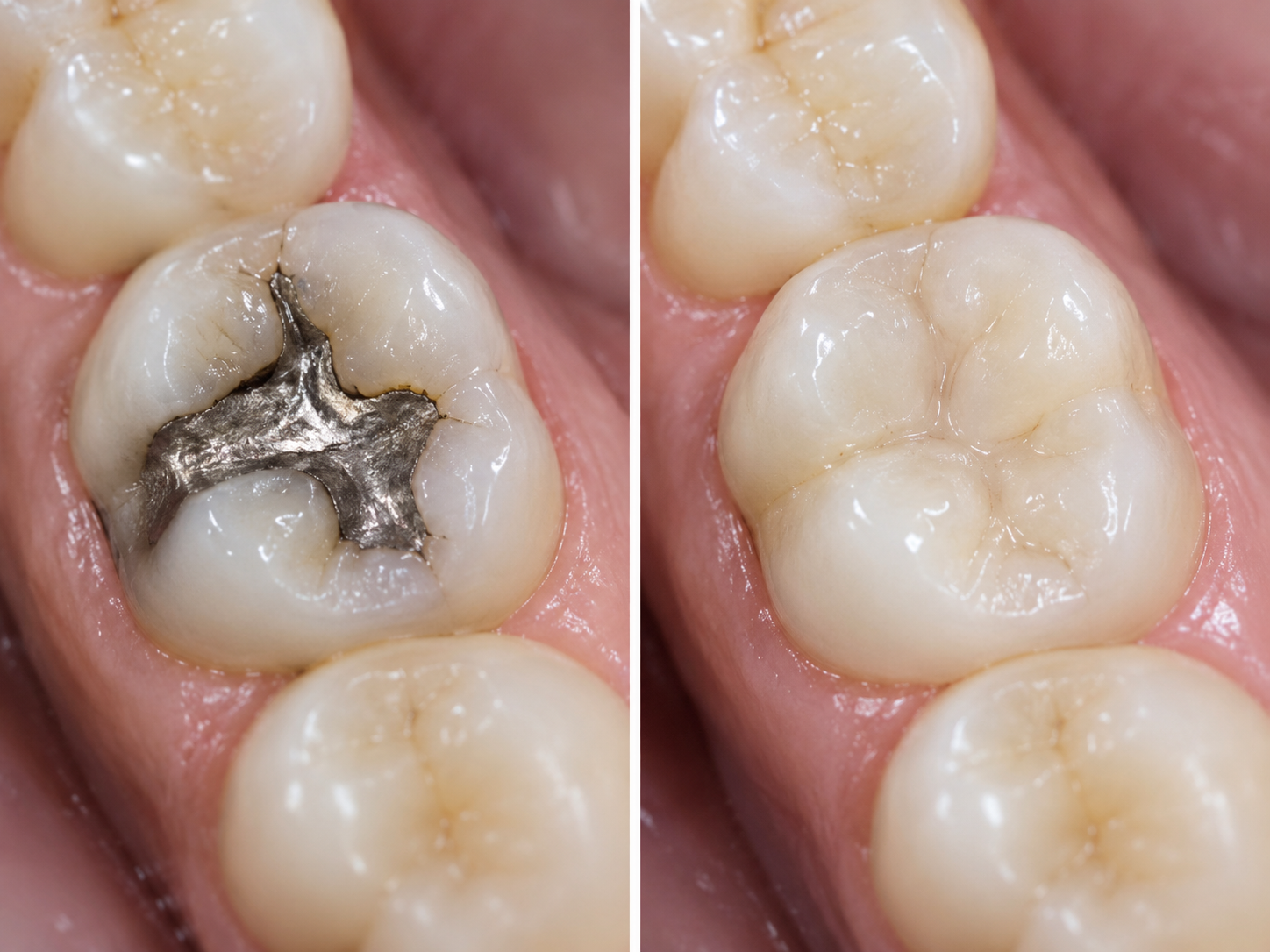
Once the amalgam is out and any decay beneath it is treated, the tooth is restored with a modern, metal-free material matched to the size of the restoration:
- Composite resin for small to medium fillings: tooth-colored, bonded directly to the tooth, and completed in the same visit.
- Ceramic inlays and onlays for larger restorations where composite would be under-built for the chewing load.
- A full ceramic crown when the old filling was large enough that the remaining tooth structure needs complete coverage. Our guide to metal-free dental crowns covers the material options in depth.
Every replacement material we use is metal-free and biocompatible, consistent with the biological philosophy that runs through our whole practice, from ozone therapy to zirconia dental implants.
Questions To Ask Any Dentist Before Amalgam Removal
Wherever you have this done, and whoever does it, these questions separate a mercury-safe office from an ordinary one:
- Do you follow the SMART protocol or an equivalent mercury-safe technique, and can you walk me through your steps?
- Will a rubber dam, external oxygen, and high-volume suction be used during my removal?
- Is removal clinically indicated for my filling, or is it optional in my case?
- What material will replace the filling, and why is it right for this tooth?
- Is your license in good standing, and what training do you have in mercury-safe removal?
Wondering About Your Own Fillings?
Bring your questions to an exam. We will assess the condition of your existing fillings honestly, tell you if anything actually needs attention, and explain your options either way.
Amalgam Removal FAQs
The questions patients ask most about silver fillings and safe removal.
Is it safe to remove amalgam fillings?
Yes, when removal is clinically indicated and performed with proper protective measures. The moment of removal is when mercury vapor exposure peaks, which is why mercury-safe offices use protocols like SMART: rubber dam isolation, external oxygen, high-volume suction, water cooling, and sectioned removal. With those safeguards in place, removal is a safe, routine procedure.
Should I have my intact silver fillings removed?
The FDA and ADA advise against removing intact, well-functioning amalgam fillings solely to eliminate mercury, because drilling out a sound filling creates more vapor exposure than leaving it in place, and it sacrifices healthy tooth structure. Removal makes sense when a filling is decayed, cracked, leaking, or when a documented sensitivity exists, and it remains a personal option worth discussing openly if you prefer metal-free restorations. An exam tells you which category your fillings are in.
What is the SMART protocol in dentistry?
SMART stands for Safe Mercury Amalgam Removal Technique, a protocol developed by the International Academy of Oral Medicine and Toxicology (IAOMT). It combines rubber dam isolation, an external oxygen supply for the patient, high-volume suction with air filtration, continuous water cooling, cutting the filling into sections rather than grinding it, protective barriers, and environmentally safe disposal. Together, these measures minimize mercury exposure for the patient, the dental team, and the environment.
What happens if I swallow a piece of amalgam filling?
Usually nothing harmful. Solid elemental mercury is very poorly absorbed by the digestive tract, so a swallowed fragment typically passes through the body without significant absorption. The meaningful exposure route is mercury vapor inhaled during drilling, which is exactly what safe-removal protocols are built to control. If you ever have concerns after swallowing dental material, mention it to your dentist or contact Poison Control for guidance.
What replaces an amalgam filling after removal?
It depends on the size of the restoration. Small to medium fillings are replaced with tooth-colored composite resin in the same visit. Larger restorations may call for a ceramic inlay or onlay, and when the old filling was very large, a full ceramic crown protects the remaining tooth structure best. All the replacement options we use are metal-free and biocompatible, and we will recommend the one that matches your tooth's actual needs.
How do I find a dentist who removes amalgam safely?
Ask directly whether the office follows the SMART protocol or an equivalent mercury-safe technique, and ask them to describe the specific safeguards they use: rubber dam, external oxygen, high-volume suction, water cooling, and sectioned removal. Verify that the dentist's state license is in good standing, and look for specific training in mercury-safe removal. Any office doing this properly will answer those questions happily. At our Costa Mesa practice, SMART removal is a core service, and we welcome exactly these questions.
Talk To A Mercury-Safe Dentist In Costa Mesa
Have questions about your fillings? Reach out and we will schedule an exam, give you an honest assessment, and walk through your options together.
Location
488 E 17th St. Suite A-101
Costa Mesa, CA 92627
Working Hours
Monday: 8am–4pm
Tuesday: 8am–4pm
Wednesday: 8am–4pm
Thursday: 8am–4pm
Friday: 8am–1pm
Your Fillings, Your Choice, Made Safely
Whether your amalgam fillings need attention or just an honest look, you deserve answers grounded in evidence and a removal protocol that takes safety seriously.
