
Safe Amalgam Filling Removal in Costa Mesa, CA
Mercury amalgam fillings can be removed safely using the SMART protocol — protecting you from vapor exposure every step of the way. Learn what the process involves and whether removal is right for you.
At Brite Clean Smiles in Costa Mesa, we offer safe amalgam removal using the SMART protocol — a rigorous set of protective measures developed by the International Academy of Oral Medicine and Toxicology (IAOMT) to minimize mercury vapor exposure for patients and staff during the removal process. Here’s what the procedure involves, when removal makes clinical sense, and what to expect.
Safe Amalgam Removal — The 6-Step Process
Every amalgam removal at our Costa Mesa office follows the SMART protocol — protecting your health from start to finish.
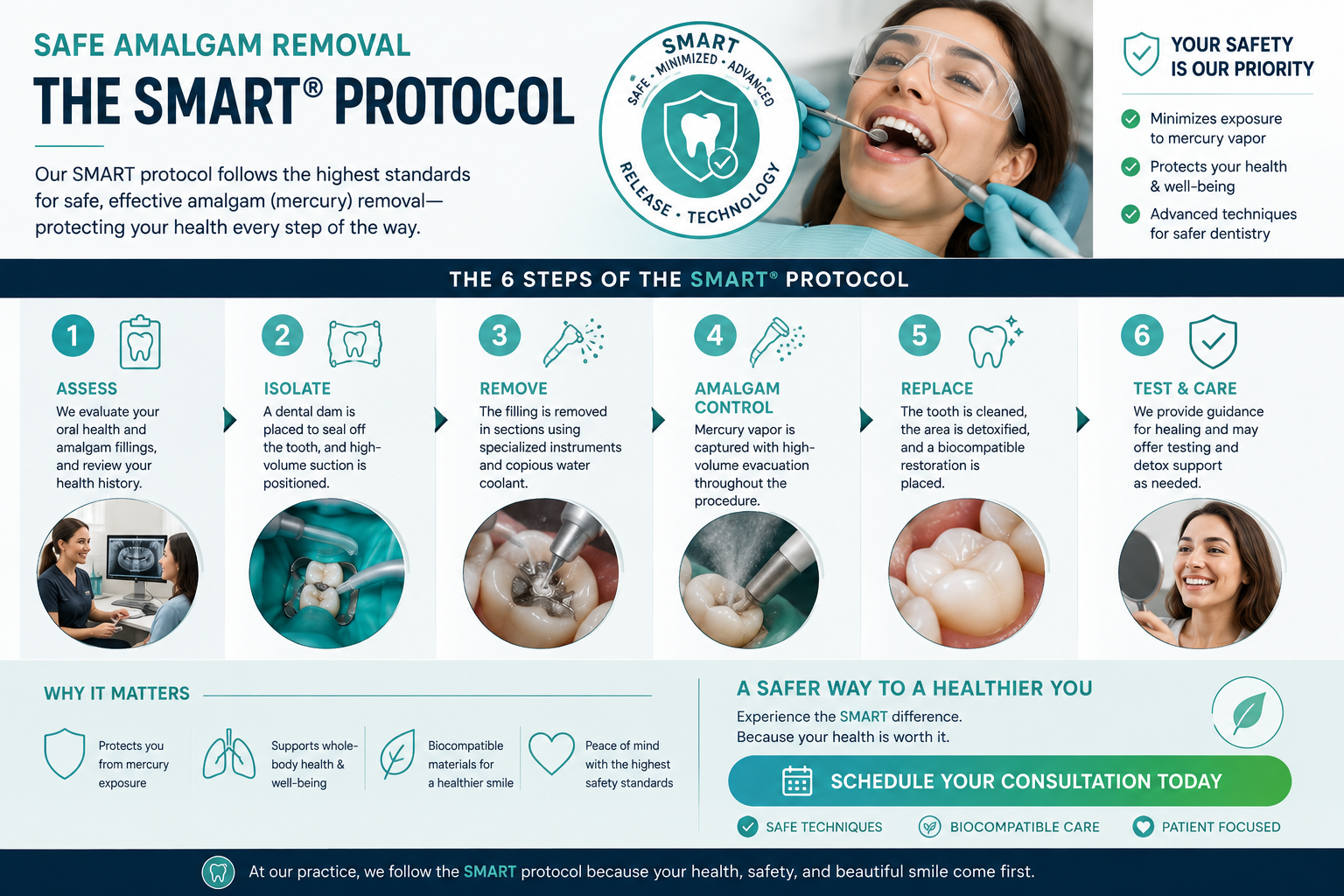
Amalgam Removal — The Complete Picture
Understanding both the risks and the safeguards helps you make an informed decision about whether removal is right for you.
Is Removing Your Amalgam Fillings the Right Call?
Removing intact, structurally sound amalgam fillings purely for preventive reasons is generally not recommended by major health agencies — the drilling process itself creates a temporary spike in mercury vapor exposure. However, safe amalgam removal is clinically justified in several specific situations.
The most common valid reasons include: a filling that is cracked, fractured, or leaking and allowing decay to form beneath it; recurrent cavities around an existing amalgam; a documented allergy or sensitivity to mercury or other metals in the amalgam alloy; or a preference for mercury-free, tooth-colored restorations for biocompatibility or aesthetic reasons.
When any of these conditions apply, removal performed with proper SMART protocol safeguards is considered safe and clinically appropriate. A consultation and X-ray at our Costa Mesa office will show us exactly what each filling looks like and whether the case for removal is sound.
Cracked or Failing Filling
Fractures, leaking margins, or decay beneath the filling are the most common and clinically clear reasons for removal and replacement.
Metal Allergy or Sensitivity
Documented hypersensitivity to mercury, tin, or other metals in dental amalgam is a valid medical reason for replacement with a biocompatible material.
Biocompatibility Preference
Patients who prefer mercury-free, tooth-colored composite restorations for holistic or aesthetic reasons — even if the filling is structurally sound.
What Replacement Looks Like
After removal, the tooth is restored with a tooth-colored composite or ceramic restoration — no metal, no mercury, and a natural appearance that matches surrounding enamel.
Why Protocol Matters During Amalgam Removal
The primary risk of amalgam removal is not the filling itself — it’s the drilling process. When a drill contacts amalgam, it generates heat that converts some of the mercury in the filling into vapor and fine particles. Without proper precautions, that vapor can be inhaled by both the patient and the dental team.
The SMART protocol addresses this risk at every stage: the tooth is isolated with a rubber dam to prevent swallowing debris; the patient breathes through an alternative air source rather than the air in the treatment area; high-volume evacuation suction captures vapors close to the source; and the filling is sectioned into large chunks rather than ground into fine dust — which significantly reduces the surface area releasing vapor during removal.
When these safeguards are in place, the temporary mercury exposure during a properly performed removal is minimal. The risk of doing nothing is greater when the filling is already compromised — a cracked or leaking amalgam releases mercury vapor continuously from normal chewing and temperature changes.
Mercury Vapor from Drilling
Heat during drilling converts amalgam mercury to vapor. SMART protocol suction and cooling water dramatically reduce patient and staff exposure.
Tooth Structure Loss
Removing any filling requires removing a small amount of surrounding enamel — this is minimized by sectioning the filling in chunks rather than grinding.
Temporary Sensitivity
Some soreness and cold sensitivity is normal for several days after removal as the tooth and surrounding tissue adjust to the new composite restoration.
No Proven Systemic Health Benefit
Major health agencies note that removing intact, sound fillings does not reliably cure systemic symptoms — removal is best reserved for clear clinical indications.
The 6 Steps of Safe Amalgam Removal at Our Office
Every amalgam removal at Brite Clean Smiles follows the IAOMT SMART framework from assessment through post-procedure care.
Assess
We evaluate your oral health, review your existing amalgam fillings with X-rays, and discuss your health history and goals before any removal is recommended.
Isolate
A non-latex rubber dam is placed to seal off the tooth and prevent you from swallowing any debris or particles during the procedure.
Remove
The filling is sectioned into large chunks using a small drill and copious water coolant — minimizing heat, vapor, and fine particle generation throughout.
Amalgam Control
High-volume evacuation suction is positioned 2 to 4 inches from the tooth throughout removal, capturing mercury vapors before they can be inhaled.
Replace
The area is cleaned and a biocompatible tooth-colored composite or ceramic restoration is placed — restoring the tooth to full function with no metal.
Test & Care
We check your bite, provide post-procedure guidance, and discuss any detox or follow-up support options if requested.
Considering Amalgam Removal in Costa Mesa?
A consultation and X-ray is the right first step. We’ll assess your fillings, tell you honestly whether removal is indicated, and walk you through the SMART protocol process.
Amalgam Filling Removal in Costa Mesa — FAQs
The questions we hear most from patients considering safe amalgam removal.
Is it safe to remove old amalgam fillings?
Yes — when performed by a dentist trained in the SMART protocol and using proper isolation and evacuation safeguards. The main risk during amalgam removal is the temporary spike in mercury vapor generated by the drilling process. SMART protocol protections — rubber dam isolation, alternative air source, high-volume evacuation, and chunk sectioning rather than grinding — reduce that exposure to minimal levels. That said, removing perfectly intact, structurally sound fillings purely for preventive reasons is generally discouraged by major health agencies, as the procedure itself carries an avoidable exposure. The strongest cases for removal are structurally failing fillings, documented metal allergy, or a personal preference for biocompatible materials.
What are the potential side effects of removing amalgam fillings?
Without proper safety measures, drilling out amalgam can cause inhalation of mercury vapor and fine metallic dust — potentially leading to temporary symptoms including a metallic taste, headache, nausea, or mild respiratory irritation. With the SMART protocol in place, these risks are significantly mitigated. After the procedure, it is normal to experience mild tooth sensitivity to hot and cold temperatures for several days as the tooth adjusts to the new composite restoration. Any persistent post-procedure symptoms should be discussed with your dentist.
What is the SMART protocol for amalgam removal?
SMART stands for Safe Mercury Amalgam Removal Technique — a set of rigorous safety standards developed by the International Academy of Oral Medicine and Toxicology (IAOMT). The protocol includes isolating the tooth with a non-latex rubber dam to prevent swallowing debris; providing the patient with an alternative air source (nasal mask with clean oxygen) so they do not breathe mercury-laden air; using copious cool water to suppress vapor generation during drilling; sectioning the filling into large chunks rather than grinding it into fine dust; positioning high-volume evacuation suction 2 to 4 inches from the tooth; and using protective coverings for both patient and staff. Together these measures minimize mercury exposure to the lowest achievable level during removal.
Does removing amalgam fillings hurt?
The removal procedure is performed under local anesthesia — you should feel pressure and vibration but not pain during the actual drilling. After the anesthetic wears off, mild soreness and gum tenderness are common for several days, along with some sensitivity to hot and cold as the tooth adjusts to the new composite restoration. Most patients find the post-procedure discomfort manageable with over-the-counter pain relief and report it resolving within a week.
Can removing amalgam fillings improve my health?
According to major public health agencies including the FDA and CDC, there is no reliable clinical evidence that removing structurally intact, sound amalgam fillings cures systemic health conditions, chronic fatigue, or autoimmune issues. Many patients who undergo removal for biocompatibility reasons report feeling better afterward, but this has not been consistently demonstrated in controlled clinical studies. What is well-established is that structurally failing amalgam fillings — cracked, leaking, or decayed beneath — should be replaced, and doing so with biocompatible tooth-colored materials eliminates ongoing low-level exposure from a compromised restoration. A consultation and honest conversation with our Costa Mesa team will help you understand what the evidence supports for your specific situation.
Schedule Your Amalgam Removal Consultation in Costa Mesa
Reach out and we’ll get you scheduled. We’ll review your fillings with X-rays and give you an honest recommendation before anything is decided.
Location
488 E 17th St. Suite A-101
Costa Mesa, CA 92627
Hours
Mon–Thu: 8am–4pm
Friday: 8am–1pm
Safe Amalgam Removal — Done Right, From the Start
SMART protocol safeguards. Biocompatible tooth-colored restorations. Honest advice on whether removal makes sense for your specific case.
