
Veneers vs.
Dental Bonding in Costa Mesa
Both transform your smile — but they work differently, last differently, and suit different goals. Here’s how to tell which one is right for you.
Chips, gaps, discoloration, uneven edges — both porcelain veneers and dental bonding can address them. But they do it through completely different approaches, with different lifespans and different levels of commitment. At Brite Clean Smiles in Costa Mesa, we offer both — and our job is to make sure you understand which one actually fits your situation before any treatment begins.
How They Compare at a Glance
A clear breakdown of veneers and dental bonding across the factors that matter most — appearance, durability, invasiveness, and who each option serves best.
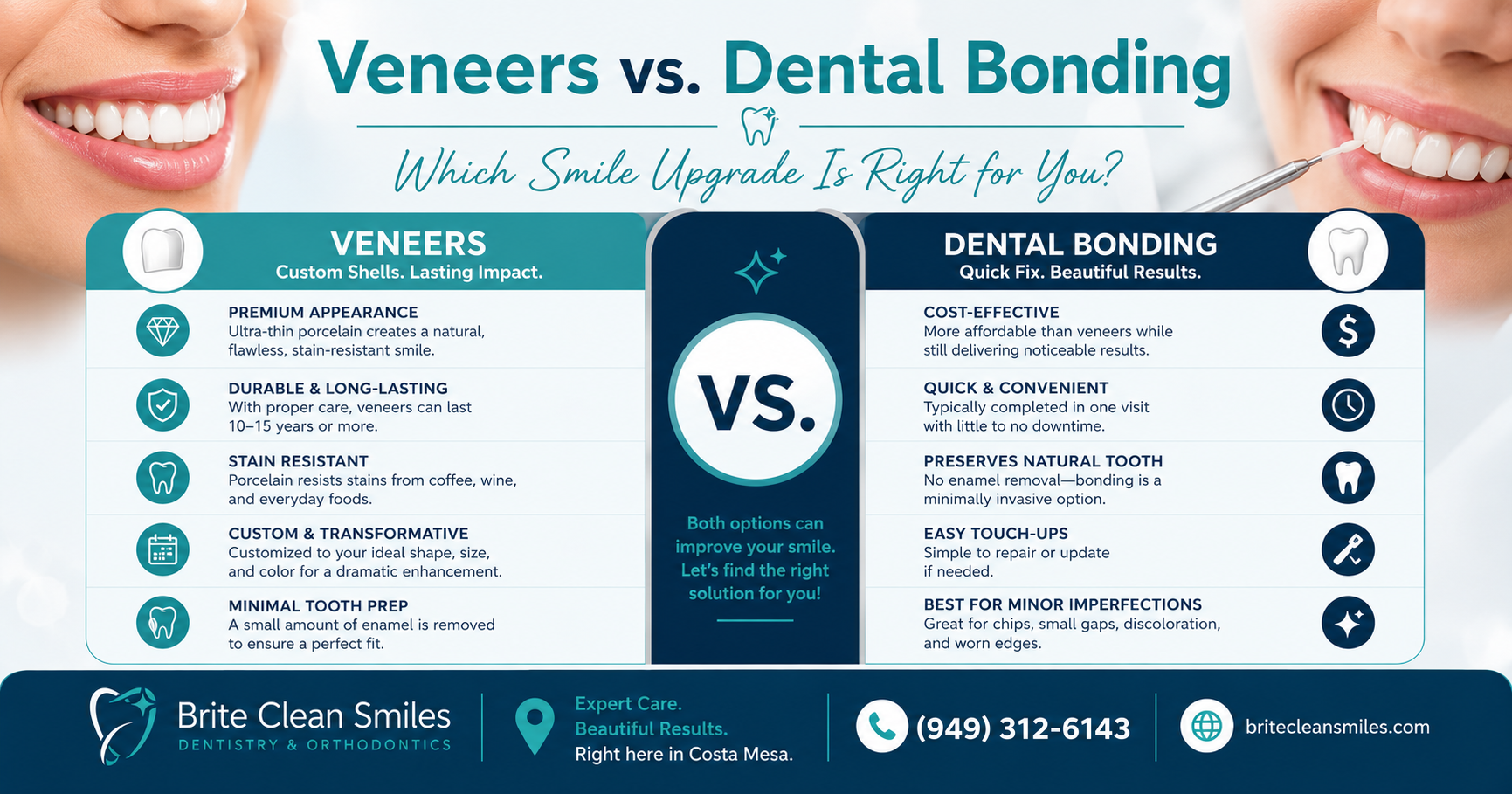
Veneers vs. Dental Bonding
Both are legitimate cosmetic treatments — the right one depends entirely on what you’re trying to fix, how permanent you want the result, and how much of the tooth you want to cover.
Custom Shells. Lasting Impact.
- Ultra-thin porcelain shells cover the entire front surface for a complete transformation
- Mimics the natural translucency of enamel — the most lifelike cosmetic result available
- Non-porous porcelain resists staining from coffee, tea, and wine indefinitely
- Lasts 10 to 15 years or longer with proper care and regular checkups
- Requires removing a thin layer of enamel — the procedure is permanent
- Best for multiple teeth, significant color changes, or a full smile transformation
Quick Fix. Beautiful Results.
- Tooth-colored composite resin applied and sculpted directly onto the tooth
- Matches surrounding teeth well but can look slightly opaque under certain lighting
- Resin is porous — gradually absorbs stains and dulls over time
- Lasts 3 to 7 years — touch-ups or replacement needed as it wears
- Minimal to no enamel removal — largely reversible, conservative treatment
- Best for minor, localized fixes — a small chip, a single gap, slight discoloration
The Procedure Behind Each Treatment
Understanding what happens during each treatment — and what that means for your tooth long-term — is one of the most important parts of making the right choice.
How Veneers Work
A porcelain veneer is a custom-fabricated shell, typically 0.5 to 1mm thick, bonded to the front surface of the tooth. The process starts with a consultation and smile design, where shade, shape, and size are planned around your face and goals. At the prep appointment, a precise micro-thin layer of enamel is removed so the veneer sits flush at the gumline — impressions or a digital scan are taken, and temporaries protect the teeth while the lab fabricates the final porcelain shells.
At the final visit, the veneers are bonded permanently using dental cement and cured with a light. Because porcelain is entirely non-porous, it holds its color, polish, and translucency for the full lifespan of the veneer. The result is a cosmetic change that looks and feels completely natural — indistinguishable from healthy enamel.
The key commitment: because enamel was removed, the tooth will always need a veneer going forward. This is a permanent procedure — and a long-term investment worth understanding before moving forward.
How Dental Bonding Works
Dental bonding is a single-visit chairside procedure. A tooth-colored composite resin is selected to match your natural enamel, then applied directly to the affected area of the tooth. The dentist sculpts and shapes the resin by hand — building up a chip, closing a small gap, covering a stain, or reshaping a worn edge — then hardens it with a curing light and polishes the surface to blend seamlessly.
Because bonding targets only the specific problem area, little to no enamel is removed, making it one of the most conservative cosmetic treatments available. For patients who want to correct something minor without committing to an irreversible procedure, it’s a highly practical option.
The trade-off is longevity and aesthetics over time. Composite resin is softer and more porous than porcelain — it gradually absorbs pigment from food and drink, and the surface can dull or chip under biting pressure over the years. Most bonding needs touch-ups or full replacement somewhere in the three-to-seven-year range.
Single Visit, No Lab Required
Everything happens chairside — no impressions, no temporaries, no waiting for a lab. Most bonding cases are done in one appointment.
Conservative by Design
Because resin is applied on top of the tooth rather than underneath it, minimal enamel is disturbed — making bonding one of the most reversible cosmetic options.
Easy to Repair
If the bonding chips or stains, repair is straightforward — the affected area can be touched up or replaced without disturbing the rest of the tooth.
Durability Has Limits
Composite is softer than porcelain. On biting edges or high-pressure areas, it wears faster — habits like nail biting or chewing ice can significantly shorten its lifespan.
Who Each Option Tends to Suit Best
The right choice comes down to what you’re trying to fix, how long you want it to last, and how much of the tooth you want covered. Here’s a practical guide.
Veneers Tend to Suit
- Multiple teeth needing a consistent, uniform transformation
- Deep or widespread discoloration that whitening can’t fix
- Patients wanting the longest-lasting cosmetic result
- Anyone who wants maximum stain resistance long-term
- Cases where shape, length, and color all need changing at once
Bonding Tends to Suit
- A single chipped, cracked, or slightly gapped tooth
- Minor localized discoloration on one or two teeth
- Patients who want a conservative, reversible option first
- Younger patients whose teeth are still developing
- Anyone wanting a fast result without a multi-visit commitment
When Only a Consult Decides
- You like the idea of bonding but want it to last longer
- You want veneers but aren’t sure if it’s overkill for your case
- Multiple teeth with different types of damage
- You’ve had bonding before and want to explore a longer-term option
- Anything where seeing the tooth in person changes the recommendation
Not Sure Which One Your Smile Needs?
The right call depends on what we see in person. Our Costa Mesa team will examine your teeth, understand your goals, and give you a straight recommendation — no pressure either way.
Veneers vs. Bonding — FAQs
The questions we hear most when patients are deciding between these two cosmetic treatments in Costa Mesa.
Is dental bonding cheaper than veneers?
Bonding has a lower upfront investment than veneers because it’s done chairside in a single visit with no lab fabrication involved. Veneers require multiple appointments, custom porcelain fabrication, and more clinical preparation — which is reflected in the overall investment. That said, bonding typically needs to be replaced or touched up every three to seven years, while veneers can last a decade or more. Over the long run, the gap in total investment often narrows significantly. For a personalized estimate based on your specific teeth and goals, the best step is a consultation with our Costa Mesa team.
Which looks more natural — bonding or veneers?
Both can look very natural in skilled hands, but veneers generally produce a more consistent, long-term aesthetic result. Porcelain mimics the way natural enamel reflects and transmits light, giving it a depth and translucency that composite resin has difficulty matching exactly — especially under different lighting conditions. Bonding can look slightly opaque compared to surrounding natural teeth, and as the resin absorbs stains over time, color-matching becomes harder to maintain. For a single small correction, bonding looks excellent. For a full smile transformation involving multiple teeth, veneers deliver a more uniform, lasting result.
Can dental bonding fix the same problems as veneers?
For minor issues — a small chip, a single gap, slight discoloration on one tooth — bonding can absolutely produce a beautiful result that rivals veneers visually. Where bonding falls short is in scale and longevity. If you have widespread discoloration across multiple teeth, significant shape changes needed, or you want a result that stays consistent for a decade without maintenance, veneers are the better clinical tool. Bonding also wears faster on biting edges, so for front teeth that take a lot of pressure, it may not hold up as well as porcelain.
How long does dental bonding last compared to veneers?
Dental bonding typically lasts three to seven years before it needs touch-ups or full replacement — though this varies significantly based on where the bonding is placed, your bite, and habits like teeth grinding or nail biting. Porcelain veneers are more durable and commonly last ten to fifteen years with good hygiene and regular checkups, and many last even longer. Neither is maintenance-free, but porcelain holds its appearance far more consistently over its full lifespan without discoloring or chipping under normal wear.
Is getting veneers painful?
The preparation appointment — where the thin layer of enamel is removed — is done under local anesthesia, so you shouldn’t feel pain during the procedure. Some patients experience mild sensitivity afterward, especially while wearing temporaries, because the prepared tooth is slightly more exposed than usual. Once the permanent veneers are bonded in place, most patients report no ongoing sensitivity. The bonding procedure for composite is even less involved — no anesthesia is typically needed, and there’s rarely any post-procedure discomfort.
Can I whiten my teeth if I have bonding or veneers?
Neither porcelain nor composite resin responds to whitening treatments — only natural enamel whitens. This is an important consideration for both options. If you’re thinking about whitening, the right sequence is to whiten your natural teeth first, then match the bonding or veneers to that brightened shade. If you whiten after the restorations are placed, your natural teeth will lighten but the veneers or bonding will stay the same color, creating a visible mismatch. Our Costa Mesa cosmetic team will walk you through the right sequence at your consultation.
Schedule Your Cosmetic Consultation in Costa Mesa
Reach out and we’ll get you scheduled. We’ll look at your teeth, understand what you want to change, and give you a clear recommendation on whether veneers or bonding is the right fit.
Location
488 E 17th St. Suite A-101
Costa Mesa, CA 92627
Hours
Mon–Thu: 8am–4pm
Friday: 8am–1pm
Ready to Transform Your Smile?
Whether veneers or bonding is the right fit, our Costa Mesa team will help you get the result you’re after — natural-looking, done right, built to last.
