
Dental Implants vs.
Dentures in Costa Mesa
Two very different answers to missing teeth — one permanent, one removable. Here’s what sets them apart so you can make the right call for your smile and your life.
Missing teeth affect more than appearance — they change how you eat, speak, and carry yourself. At Brite Clean Smiles in Costa Mesa, we offer both dental implants and denture solutions, and we take the time to walk you through exactly which fits your bone health, your lifestyle, and your long-term goals before anything is recommended.
How They Compare at a Glance
A clear breakdown of how dental implants and dentures differ across the factors that matter most — stability, bone health, comfort, longevity, and daily life.
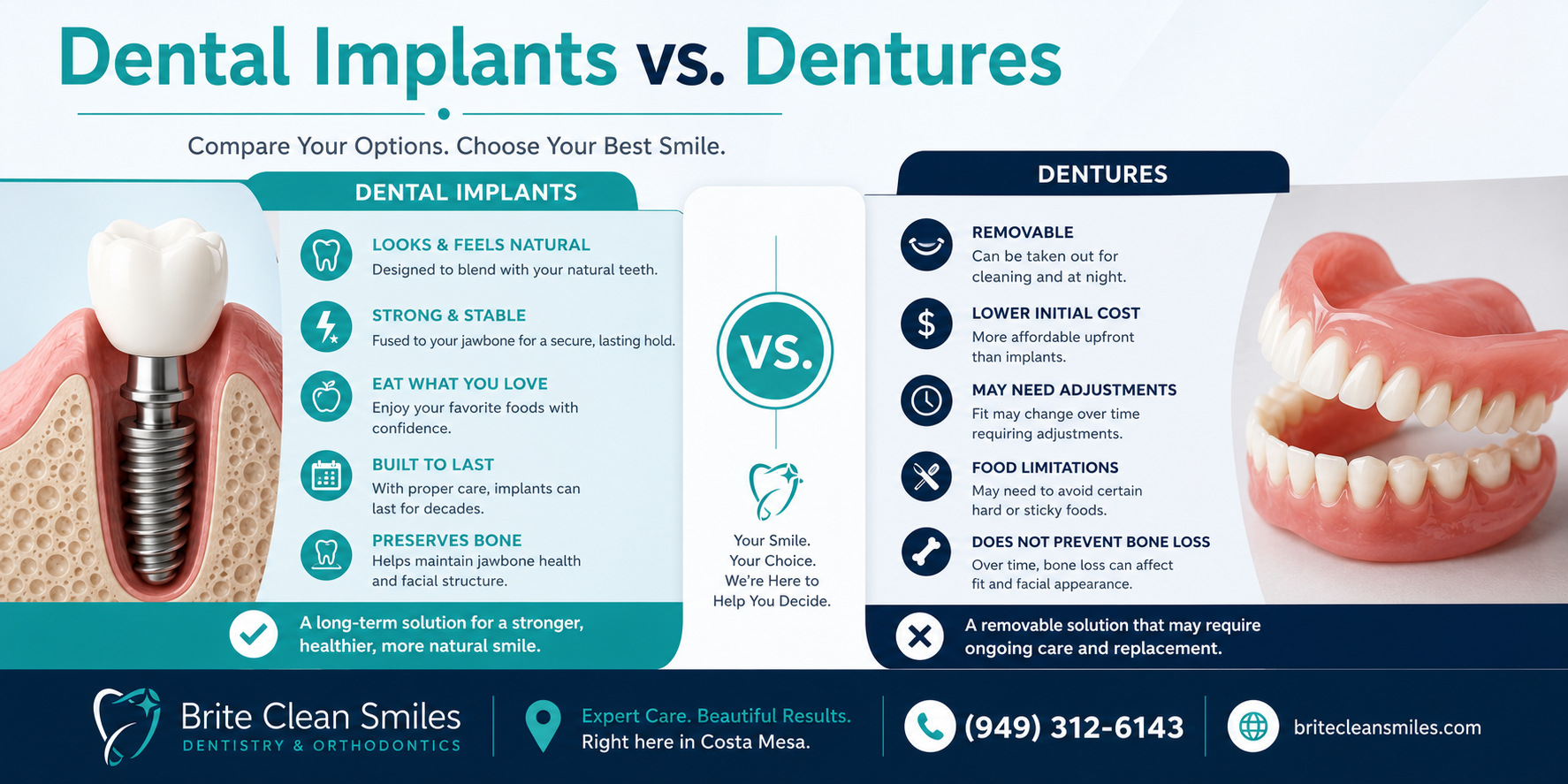
Dental Implants vs. Dentures
Both replace missing teeth — but the experience, the biology, and the long-term outcomes are fundamentally different. Here’s how they stack up honestly.
Permanent Root Replacement
- Titanium post fuses to the jawbone — no slipping, clicking, or shifting
- Stimulates the jawbone with every bite, preventing bone loss and facial collapse
- Looks, feels, and functions like a natural tooth — no special cleaning routine
- No food restrictions — eat what you love with full biting confidence
- Designed to last decades — often a lifetime with proper care
- Requires adequate bone density and a minor surgical procedure to place
Removable Prosthetic Teeth
- Rest on the gums — non-surgical, faster path to a restored smile
- Do not stimulate bone — jawbone gradually resorbs and changes shape over time
- Removed nightly for cleaning — require adhesives to stay secure in many cases
- Some food limitations — hard, sticky, or chewy foods can be difficult
- Fit loosens as bone changes — relining or replacement needed every 5 to 8 years
- More accessible upfront — a practical option for patients who aren’t implant candidates
The Biology Behind Each Option
Understanding what each treatment actually does inside your mouth helps set realistic expectations — and makes the decision a lot clearer.
How an Implant Works
A dental implant replaces the full structure of a natural tooth — not just the visible crown, but the root beneath the gum. A small titanium post is placed directly into the jawbone during a minor in-office procedure. Over the following months, the bone grows around and fuses to the post — a process called osseointegration — anchoring it permanently.
Once healed, a custom ceramic crown is attached to the post. The result functions exactly like a real tooth: it stimulates the jawbone every time you chew, keeping the bone dense and preserving your facial structure. Because the implant is fixed and fused to bone, there’s nothing to remove, no adhesive required, and no slipping under pressure.
Implant-supported dentures — sometimes called snap-on or All-on-4 — use a small number of implants to anchor a full arch of teeth, combining the stability of implants with the coverage of a denture.
Osseointegration
The bone fuses to the titanium post over 3 to 6 months — creating an anchor as strong as a natural tooth root.
Bone Stimulation
Every bite sends force through the implant into the jawbone — the same signal a natural root provides to keep bone density stable.
No Moving Parts
Once placed and healed, an implant is permanent. No adhesive, no removal, no soaking — brush and floss like a natural tooth.
Implant-Supported Dentures
2 to 6 implants can anchor a full arch — eliminating slippage and bone loss while restoring a full set of teeth in one solution.
How Dentures Work
Traditional dentures are custom-fabricated acrylic prosthetics that sit on top of the gums, held in place by suction, natural muscle control, or adhesive. Partial dentures clip to remaining natural teeth; full dentures replace an entire arch. No surgery is required — impressions are taken, the prosthetic is fabricated, and it’s fitted over several appointments.
The key biological limitation of traditional dentures is bone resorption. Because the gum tissue bears all the load — rather than the bone — the jawbone receives no stimulation and begins to gradually shrink. As the bone changes shape, the fit of the denture changes with it. Most dentures need to be relined or fully replaced every five to eight years as a result.
For patients who are not candidates for implants — due to insufficient bone, medical conditions, or other factors — dentures remain a practical, non-invasive way to restore a functional smile while long-term options are explored.
Gum-Supported Design
Dentures rest on soft tissue — no surgery, no healing time, and a faster path to tooth replacement.
Bone Resorption Over Time
Without a root to stimulate it, bone shrinks — changing the denture’s fit and eventually affecting facial structure.
Relining and Replacement
As the jaw changes shape, the denture needs adjustment. Most patients require relining or a new set every 5 to 8 years.
Can Be a Bridge to Implants
Some patients start with dentures while saving for implants or waiting for bone grafts to mature — they’re not mutually exclusive long-term.
Who Each Option Tends to Suit Best
The right choice depends on your bone health, overall health, how many teeth are missing, and your long-term goals. Here’s a general guide.
Implants Tend to Suit
- Adults with one or more missing teeth and adequate bone density
- Anyone who wants a permanent, maintenance-light solution
- Patients who want full biting strength and zero food restrictions
- Those concerned about long-term jawbone preservation
- Patients replacing dentures that no longer fit well
Dentures Tend to Suit
- Patients with insufficient bone density for implants without grafting
- Those needing a faster, non-surgical tooth replacement option
- Patients replacing multiple or all teeth across a full arch
- Anyone for whom surgery is contraindicated due to health factors
- Patients looking for a practical option while exploring implants
When Only a Consult Can Decide
- Bone loss that may or may not require a graft before implants
- Existing denture wearers considering a switch to implants
- Patients with systemic health conditions affecting healing
- Anyone uncertain about the difference between their options
- Cases where implant-supported dentures may be the ideal middle ground
Not Sure Which Option Is Right For You?
An exam and X-ray tell us what your bone supports and what will serve you best long-term. Our Costa Mesa team will give you a straight answer — no pressure, no guesswork.
Implants vs. Dentures — FAQs
The questions we hear most when patients are weighing their tooth replacement options in Costa Mesa.
Are dental implants better than dentures?
In most clinical respects, yes — dental implants are considered the superior long-term solution for replacing missing teeth. They are permanently anchored in the jawbone, which means no slipping, no adhesive, and no bone loss over time. They function and feel like natural teeth and can last decades with proper care. That said, not everyone is an immediate implant candidate — adequate bone density is required, and some patients need bone grafting first. For patients who cannot have surgery or need a faster solution, dentures remain a practical and effective option. The right choice depends on your individual bone health, overall health, and goals.
What lasts longer — implants or dentures?
Dental implants last significantly longer. With proper care, the titanium post can last a lifetime — the crown on top may eventually need replacement due to normal wear, but the implant structure itself is designed to be permanent. Traditional dentures typically need to be relined or fully replaced every five to eight years, because the jawbone gradually changes shape without a root to stimulate it, causing the fit to loosen over time.
Why do dentures become loose after a few years?
Dentures lose their fit because the jawbone underneath them is slowly shrinking. Without a tooth root to stimulate it, the bone receives no signal to maintain its density and gradually resorbs. As the bone changes shape, the surface the denture rests on changes with it — creating gaps, rocking, and instability. This is one of the core long-term advantages of implants: because the titanium post acts like a root, it continues to stimulate the bone and prevent the resorption that causes dentures to loosen.
Can existing dentures be converted to implant-supported dentures?
In many cases, yes. If your existing denture is in good structural condition, it may be possible to place implants beneath it and retrofit the denture to snap onto them — dramatically improving stability without fabricating an entirely new prosthetic. If the denture is worn, poorly fitting, or misaligned, a new implant-supported restoration is usually the better path. The first step is an exam and bone assessment to determine how many implants your jaw can support and whether your current denture is a viable candidate for conversion.
Does getting a dental implant hurt?
The procedure itself is performed under local anesthesia, so you should feel pressure but not pain during placement. Most patients are surprised by how manageable the recovery is — mild soreness and swelling for a few days, typically controlled with over-the-counter pain relief. The healing phase that follows (osseointegration, where the bone fuses to the implant) takes several months but is largely symptom-free. Sedation options are available for patients who feel anxious about the procedure.
Can I get implants if I have been wearing dentures for years?
Yes — it is possible, though long-term denture wear does cause bone resorption, which may mean less available bone for implant placement. Many patients in this situation require a bone graft before implants can be placed, which adds time to the overall treatment plan. An X-ray and 3D bone assessment at your consultation will tell us exactly how much bone you have and whether grafting is needed. It is never too late to explore the option.
Schedule Your Consultation in Costa Mesa
Reach out and we’ll get you scheduled. We’ll examine your bone health, review your goals, and give you a clear recommendation before anything begins.
Location
488 E 17th St. Suite A-101
Costa Mesa, CA 92627
Hours
Mon–Thu: 8am–4pm
Friday: 8am–1pm
Ready to Find the Right Solution for Your Smile?
Whether implants, dentures, or a hybrid solution fits your case, our Costa Mesa team is here to walk you through every step — from your first exam to your final result.
