
Invisalign vs.
Braces in Costa Mesa
Two paths to a straighter smile — each with real advantages. Here’s a clear, honest comparison to help you figure out which one fits your life, your case, and your goals.
Both Invisalign and traditional braces straighten teeth — but they do it differently, feel different day to day, and suit different types of cases. At Brite Clean Smiles in Costa Mesa, we offer both options and take the time to walk you through which makes the most sense for your smile, your lifestyle, and your treatment goals before anything is recommended.
How They Compare at a Glance
Here’s an at-a-glance breakdown of how Invisalign and braces differ across the factors that matter most to patients — visibility, comfort, maintenance, and treatment control.
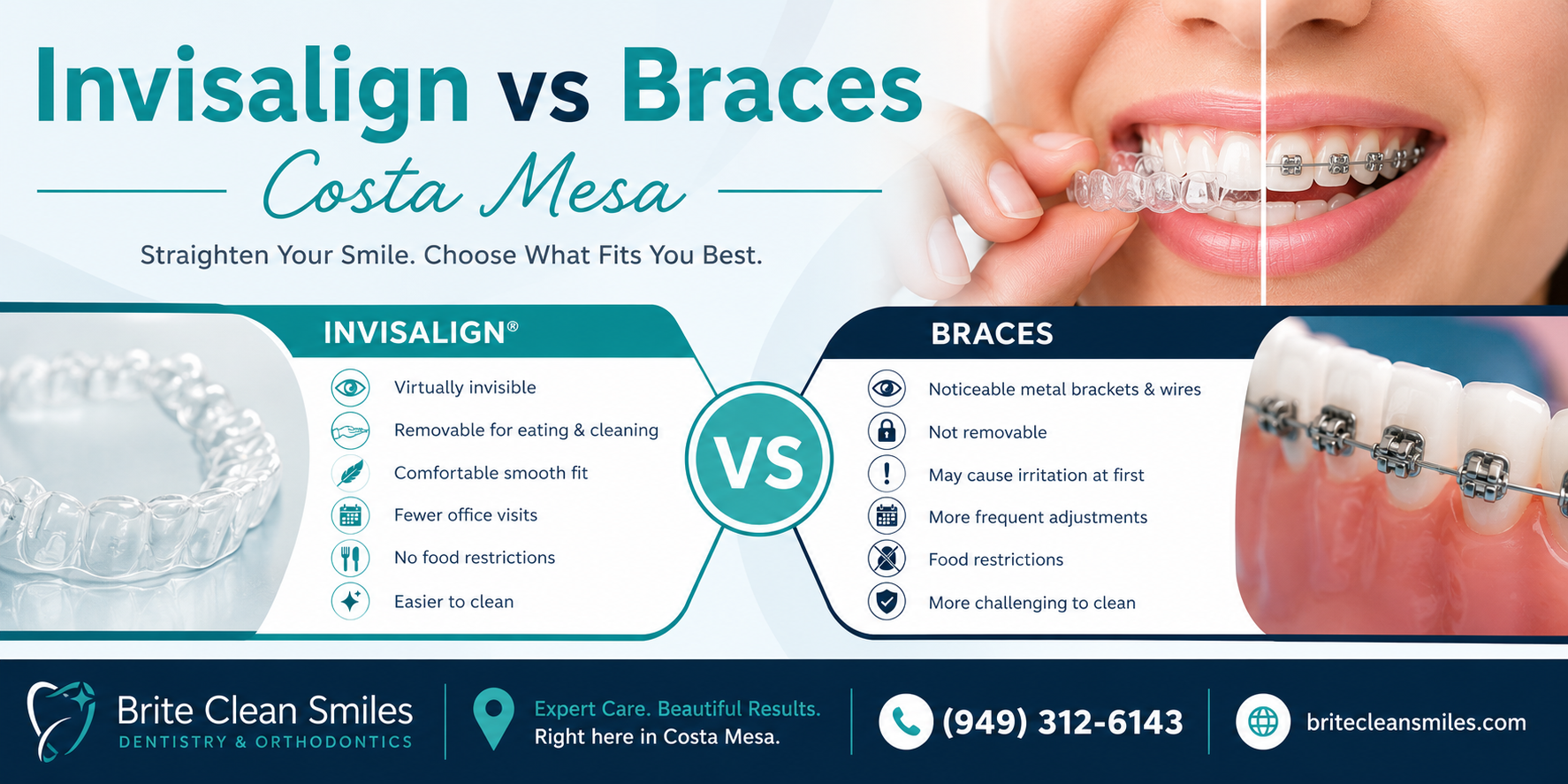
Invisalign vs. Traditional Braces
Each option has genuine strengths. Which one fits depends on your case complexity, your daily habits, and how much appearance matters to you during treatment.
Clear Aligners
- Virtually invisible — no one notices them at conversational distance
- Fully removable for eating, drinking, and brushing — no food restrictions
- Smooth thermoplastic — no wire pokes or bracket irritation
- Fewer in-office adjustment visits — digital tracking replaces manual tightening
- Best for mild to moderate crowding, gaps, spacing, and overbites
- Requires strict self-discipline — must be worn 20 to 22 hours daily
Traditional Braces
- Fixed to teeth — progress happens 24/7, no compliance required
- More precise mechanical control for severe misalignment and skeletal issues
- Gold standard for complex bite corrections and major structural movements
- Brackets and wires are visible — metal or ceramic options available
- Requires avoiding sticky, hard, and chewy foods throughout treatment
- More frequent office visits for adjustments and progress checks
The Mechanics Behind Each Treatment
Understanding how each system moves teeth helps you make a more confident decision — and sets realistic expectations for what treatment actually feels like.
How Invisalign Moves Your Teeth
Invisalign uses a series of custom-made, removable thermoplastic trays — each one shaped slightly differently from the last. Every one to two weeks you switch to the next tray in the series, and each shift moves your teeth a precise fraction of a millimeter toward the planned final position.
The treatment plan is mapped out digitally using a 3D scan of your mouth — tools like the iTero Element scanner let you and your dentist see a simulation of your expected result before a single tray is made. For cases involving overbites or rotations, small tooth-colored composite attachments are bonded to specific teeth to give the aligner extra grip.
Because the trays are removable, your oral hygiene routine stays exactly the same — no special flossing tools, no food restrictions, no dietary changes.
Digital Planning First
A 3D scan maps your teeth and plots each movement before any tray is made — so you can see your projected result at the start.
0.25mm Per Tray
Each aligner shifts teeth roughly a quarter of a millimeter. Small, precise movements add up to major changes over months.
Compliance Is Everything
Trays must stay in 20 to 22 hours a day. Taking them out too often stalls progress — or reverses it.
Attachments for Complex Cases
Small composite buttons on certain teeth help the trays grip and rotate — enabling Invisalign to tackle more than just simple spacing.
How Braces Move Your Teeth
Braces work through continuous mechanical pressure. Brackets are bonded directly to the surface of each tooth, and an arch wire threads through all of them. As the wire tries to return to its natural shape, it pulls the teeth with it — guiding them along a planned path over time.
At each adjustment visit — roughly every four to eight weeks — your dentist changes or tightens the wire to continue the progression. Because the system is fixed and working around the clock, compliance isn’t a factor. That constant force also makes braces the stronger tool for moving teeth that need significant rotation, vertical movement, or skeletal correction.
Ceramic or clear brackets are available for patients who want a less noticeable look while keeping the mechanical advantages of fixed treatment.
Works 24/7
Fixed to your teeth, braces apply consistent pressure all day and night — no patient compliance needed for progress to happen.
Better for Complex Cases
Severe crowding, significant rotations, skeletal bite corrections, and deep structural malocclusions respond better to fixed wire mechanics.
Ceramic Option Available
Clear or tooth-colored ceramic brackets reduce visibility while retaining the same structural control as metal.
Dietary Adjustments Required
Sticky, hard, and chewy foods can bend wires or pop brackets throughout treatment — a real lifestyle consideration.
Who Each Option Tends to Suit Best
Neither treatment is universally better — the right one depends on your specific case, age, lifestyle, and goals. Here’s a general guide to who each option tends to serve best.
Invisalign Tends to Suit
- Adults and older teens in professional or social settings
- Mild to moderate crowding, spacing, and standard overbites
- Patients who previously had braces and have minor relapse
- Anyone who prioritizes aesthetics during treatment
- People who are disciplined about wearing the trays consistently
Braces Tend to Suit
- Severe crowding, deep bites, complex skeletal misalignment
- Cases requiring significant tooth rotation or vertical movement
- Younger teens who may struggle with aligner compliance
- Patients where 24/7 consistent force is clinically necessary
- Anyone who prefers a set-it-and-forget-it treatment approach
When Only a Consult Can Decide
- Cases that appear moderate but have hidden complexity on X-ray
- Patients who want the look of Invisalign but have a complex bite
- Teens or adults with no prior orthodontic history
- Anyone uncertain — an exam is the only reliable way to know
- Cases where a hybrid approach may work best
Not Sure Which Is Right For Your Smile?
The only way to know for certain is an exam and a conversation about your goals. Our Costa Mesa team will walk you through exactly which option — or combination — fits your case before anything is recommended.
Invisalign vs. Braces — FAQs
The questions we hear most when patients are comparing their options in Costa Mesa.
Is Invisalign better than braces for adults?
For most adults with mild to moderate alignment issues, Invisalign is a highly effective and more convenient option — especially for professionals who prefer a discreet appearance during treatment. The removable trays mean no food restrictions and the same brushing and flossing routine. The catch is self-discipline: trays need to stay in 20 to 22 hours a day for treatment to progress on schedule. For adults with complex bite issues or severe structural problems, traditional braces may still deliver better clinical results. A consultation is the only way to know which applies to you.
Does Invisalign take longer than braces?
Not necessarily — and for simple or moderate cases, Invisalign can actually be faster. The typical Invisalign course runs 12 to 18 months, while braces average 18 to 24 months. However, if a patient is inconsistent about wearing their aligners, that timeline extends significantly. Braces work continuously because they’re fixed, so complex cases that need heavy mechanical force often complete on a more predictable schedule with traditional wire treatment.
Can Invisalign fix an overbite or crowding?
Yes — modern Invisalign handles both overbites and crowding effectively when they are mild to moderate in nature. For crowding, the aligners systematically expand the arch or reposition individual teeth to open up space. For overbites rooted in tooth positioning rather than jaw structure, small composite attachments on the teeth combined with elastic bands help guide the bite into alignment. Severe skeletal overbites — where the jaw structure itself is significantly underdeveloped — usually still require fixed braces or surgical intervention to correct properly.
Which is more painful — Invisalign or braces?
Both cause pressure and mild soreness when teeth are shifting — that discomfort is a sign things are working. The key difference is the day-to-day comfort between adjustments. Braces have metal brackets and wires that can poke and irritate the inside of the cheeks, especially after each tightening appointment. Invisalign trays are smooth thermoplastic with no sharp edges, so everyday wear tends to be more comfortable. Switching to a new tray every one to two weeks causes a brief period of pressure, but most patients describe it as less intense than a braces adjustment.
What happens if I leave my Invisalign trays out too long?
If aligners are left out consistently — during meals, social events, or simply forgotten — teeth start to drift back toward their original positions. The current tray stops fitting properly, and your overall timeline extends. In some cases, a new set of refinement trays needs to be ordered, adding time and visits to the treatment plan. This is the most common reason Invisalign cases go over schedule, and it’s entirely preventable with consistent wear habits.
Can I switch from braces to Invisalign mid-treatment?
It is possible in some cases, but it depends entirely on how far along the treatment is and what movement still needs to happen. Some phase changes are clinically straightforward; others would require starting the planning process from scratch, potentially adding significant time. If you’re currently in braces and considering a switch, the best first step is a conversation with your dentist who can evaluate your current progress and tell you honestly whether the transition makes clinical sense.
Schedule Your Consultation in Costa Mesa
Reach out and we’ll get you scheduled. We’ll examine your teeth, review your goals, and give you a clear recommendation — no pressure, no guesswork.
Location
488 E 17th St. Suite A-101
Costa Mesa, CA 92627
Hours
Mon–Thu: 8am–4pm
Friday: 8am–1pm
Ready to Straighten Your Smile?
Whether Invisalign or braces is the right fit, our Costa Mesa team is here to walk you through every step — from your first exam to your final result.
