
Wisdom teeth are the last molars to come in — usually in the late teens or early twenties — and for most people, there simply isn’t enough room in the jaw to fit them comfortably. At Brite Clean Smiles in Costa Mesa, we provide gentle, well-planned wisdom teeth removal with modern anesthesia options designed to keep you or your teenager calm and comfortable from consultation through recovery. As part of our broader oral surgery services, this is one of the most common procedures we perform.
Why Wisdom Teeth Are Removed
Even when wisdom teeth aren’t causing pain yet, leaving them in can lead to a chain of problems over time. The reason most dentists recommend early evaluation is simple: small problems are far easier to treat than large ones, and the recovery is faster the younger you are.
- Infection of the surrounding gum tissue (pericoronitis), which causes swelling, pain, and difficulty chewing or swallowing
- Cyst formation around an impacted tooth, which can slowly damage the jawbone and adjacent teeth
- Crowding of your other teeth, especially the lower front teeth — sometimes undoing the results of orthodontic work
- Damage to the neighboring molar, including decay, gum disease, and bone loss in the second molar
- Difficulty cleaning partially erupted wisdom teeth, leading to chronic gum inflammation and tooth decay
What’s Happening Beneath The Surface
Most wisdom teeth problems start where you can’t see them. The diagram below shows the typical position of an impacted wisdom tooth and the structures around it — the second molar in front, the gum tissue and periodontal ligament, the jawbone (mandible), and the inferior alveolar nerve running along the lower jaw. Understanding this anatomy is exactly why your initial evaluation includes a panoramic or 3D X-ray.
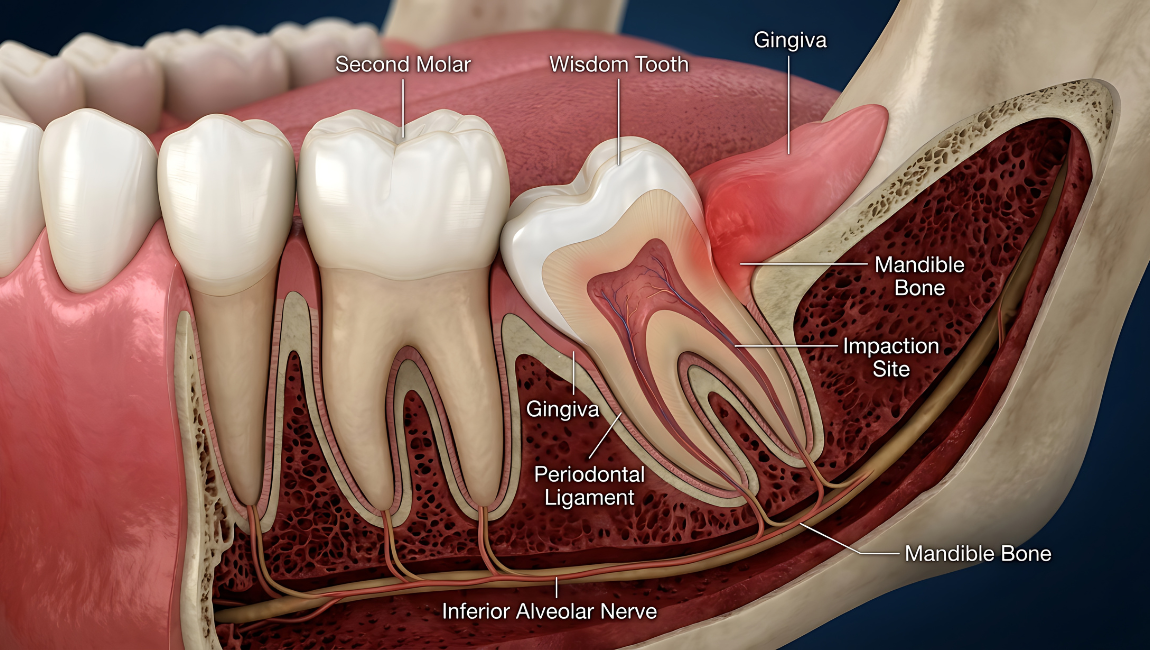
Cross-section view of a mandibular wisdom tooth and surrounding structures.
Four Ways A Wisdom Tooth Can Go Wrong
Not every wisdom tooth needs to come out, but the angle at which it’s growing usually decides the answer. Here are the four most common patterns we see on X-rays.
Vertical Impaction
The tooth grows in a normal upright direction but doesn’t fully erupt through the gum. Often the easiest type to remove.
Mesial Impaction
The most common type. The wisdom tooth tilts forward into the second molar, pressing against it and often causing damage over time.
Distal Impaction
The tooth tilts backward, away from the rest of the teeth. Less common and often more difficult to access during removal.
Horizontal Impaction
The tooth grows sideways into the second molar — the most aggressive type. Almost always requires surgical removal to prevent damage.
What To Expect From Start To Finish
Wisdom teeth removal is one of the most predictable outpatient procedures in dentistry. From the moment you arrive to the moment you head home, here’s what the day looks like.
Prep & Rest
You’ll fast for at least six hours before sedation, get a full night’s sleep, and arrange for an adult to drive you home and stay with you the rest of the day.
Settle In & Review
We confirm your medical history, review your X-rays one final time, and walk you through the anesthesia plan. You can ask any last questions before we begin.
30 To 60 Minutes
Once anesthesia is in place, the extraction itself usually takes 30 to 60 minutes depending on how many teeth are removed and the complexity of each impaction.
Rest & Recover
You’ll be drowsy for the rest of the day. We’ll send you home with detailed aftercare instructions, gauze for any bleeding, and prescriptions if needed.
Ready To Schedule A Consultation?
Every wisdom teeth case starts with a thorough evaluation and X-ray review. Reach out and we’ll walk you through the full plan before you commit to anything.
Contact Us For DetailsWhat The First Week Looks Like
Most patients are back to a near-normal routine within a week, with the worst of the swelling and discomfort behind them by day three or four. Here’s a realistic timeline.
1
The Day Of Surgery
Rest at home with your head elevated. Apply cold compresses to the outside of your cheek in 20-minute intervals to control swelling. Stick to clear liquids and soft, cool foods like broth and jello — no hot food, no dairy, no straws. Bleeding tapers off over several hours.
2–3
Peak Swelling, Then Improvement
Swelling and stiffness usually peak around day two or three — this is the part most patients dread, but it’s short. Switch from cold compresses to warm ones at this point to help blood flow. Continue with soft foods like mashed potatoes, yogurt, and scrambled eggs. Gentle saltwater rinses begin.
4–7
Steady Recovery
Discomfort drops sharply. Most patients return to school, work, or light exercise. You can gradually reintroduce firmer foods as comfort allows, while still avoiding anything crunchy, sharp, or seedy. Stitches (if used) typically dissolve on their own within 3 to 5 days.
2+
Full Healing
The gum tissue fully closes over the next few weeks. Underlying bone continues to remodel for several months, but you’ll feel back to normal long before then. We’ll typically schedule a follow-up visit to confirm everything is healing as expected.
When Should They Be Removed?
The ideal window for wisdom teeth removal is between the mid-teens and early twenties. At this age the tooth roots aren’t fully formed yet, the surrounding bone is less dense, and recovery is generally faster and more predictable. That’s why most dentists begin evaluating wisdom teeth around age 14 to 16.
That said, plenty of patients have their wisdom teeth removed later in life — sometimes well into their thirties or beyond. When removal happens later, the procedure may be a little more involved and the recovery a bit longer, but it’s still safe and routinely performed.
If you’ve been told to "watch and wait" on your wisdom teeth, the most important thing is to actually keep watching — meaning regular dental exams with periodic X-rays. The biggest mistake we see is patients who were told their wisdom teeth were fine 10 years ago and never followed up.
Wisdom Teeth FAQs
The questions we hear most from teens, young adults, and the parents bringing them in.
How painful is wisdom teeth removal?
The procedure itself is not painful — you’ll have local anesthesia, with sedation options for patients who want them. Most patients describe the surgery as something they barely remember. The recovery is where some discomfort comes in, usually peaking on day two or three. Over-the-counter pain medication like ibuprofen is enough for many patients, with prescribed pain medication available for those who need it. Most people are pleasantly surprised that it’s less painful than they expected.
Is day 3 really the worst day of recovery?
For many patients, yes. Swelling tends to peak around 48 to 72 hours after surgery, which is when stiffness and bruising are at their most noticeable. The good news is that this is the turning point — from day four onward, most patients feel measurably better each day. Keeping up with cold compresses on day one, switching to warm compresses on day two or three, staying hydrated, and resting properly all help you move through this stage faster.
Am I too old to have my wisdom teeth removed?
No. While the procedure is most predictable in the teens and early twenties, wisdom teeth are removed safely at every age. Patients in their thirties, forties, fifties, and beyond have their wisdom teeth removed routinely — especially when an active problem develops, like infection, decay, or a cyst. The recovery may take a few extra days at older ages, but the procedure itself is just as safe.
Can wisdom teeth removal fix TMJ?
Usually not directly. TMJ disorder is a condition of the jaw joint itself and is rarely caused by wisdom teeth. That said, if a wisdom tooth is forcing you to chew in an unbalanced way, or if pericoronitis is making it painful to open your mouth, removing it can relieve symptoms that mimic or worsen TMJ pain. A proper evaluation including X-rays is the only way to know whether your wisdom teeth are contributing to your jaw pain.
Do I really need to fast before surgery?
Yes, if you’re having sedation. Anything in your stomach during sedation increases the risk of nausea, vomiting, and serious anesthetic complications. We’ll ask you not to eat or drink anything — aside from a sip of water with prescription medications — for at least six hours before your appointment. If you don’t follow these instructions, the procedure will need to be rescheduled for safety reasons.
What should I avoid after surgery?
For the first 24 hours: no straws, no smoking, no spitting, and no rinsing your mouth vigorously — all of these can dislodge the blood clot that’s forming in the socket and cause a painful condition called dry socket. Avoid hot food and dairy on day one because of nausea risk with anesthesia. For the first several days, stay away from crunchy, seedy, or sharp foods that could get caught in the surgical sites. We’ll send you home with complete written aftercare instructions.
Schedule Your Wisdom Teeth Consultation
Visit our Costa Mesa office or reach out below. We’ll review X-rays, evaluate the situation, and walk through your options before any decisions are made.
Location
488 E 17th St. Suite A-101
Costa Mesa, CA 92627
Working Hours
Monday: 8am–4pm
Tuesday: 8am–4pm
Wednesday: 8am–4pm
Thursday: 8am–4pm
Friday: 8am–1pm
Gentle Wisdom Teeth Removal In Costa Mesa
Whether you’re scheduling for a teenager or finally taking care of your own wisdom teeth, we’ll guide you through every step.
Book Appointment